

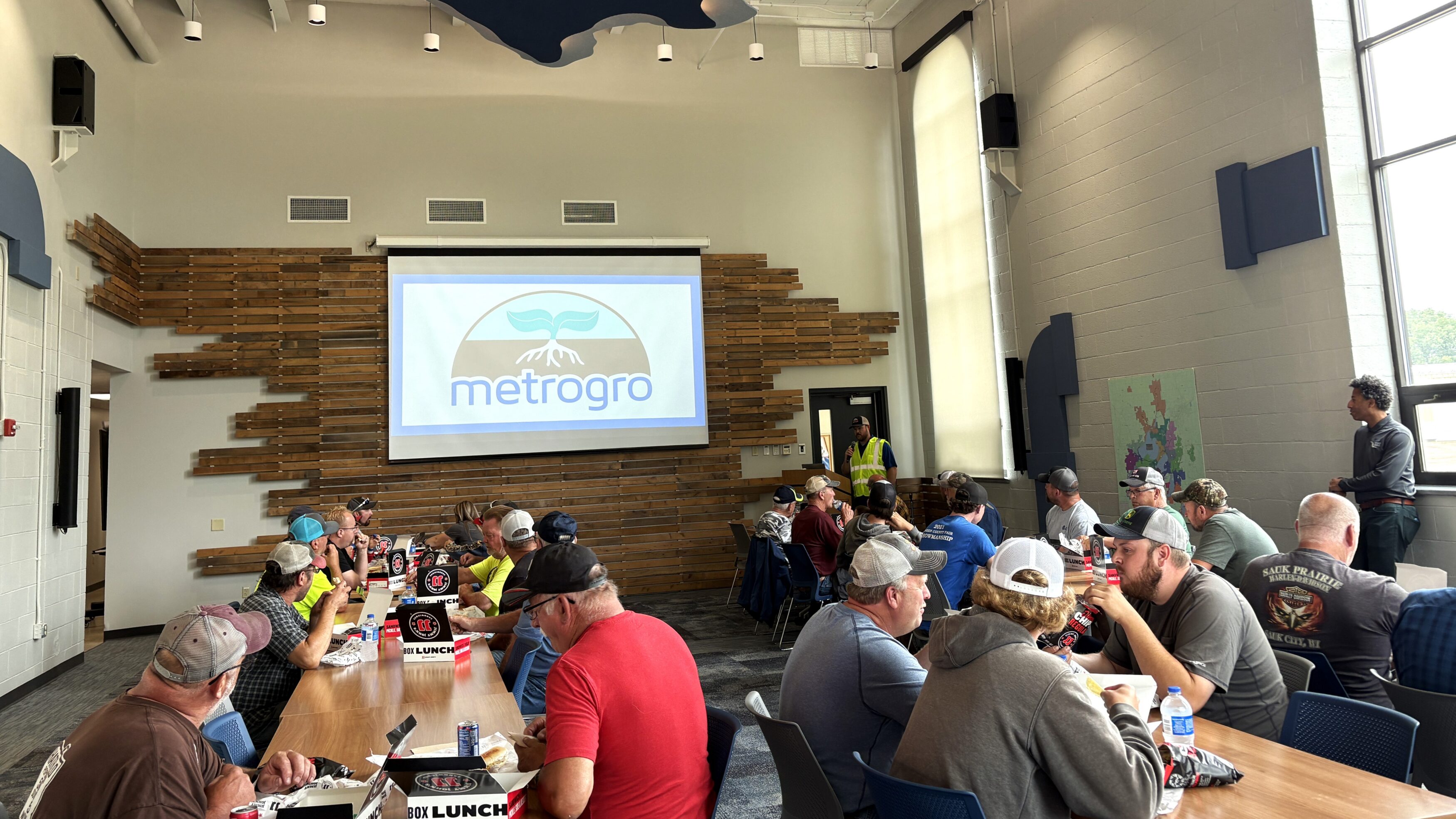
On Wednesday, June 24, Madison Metropolitan Sewerage District welcomed farmers, landowners, and haulers to the Nine Springs Wastewater Treatment Plant for a Metrogro Customer Appreciation event. It was a chance to say thank you in person and also take a moment to step back and look at what the Metrogro program accomplishes, season after season, for our land, our water, and our community.
A PROGRAM BUILT ON PARtNERSHIP
Metrogro turns biosolids recovered through the wastewater treatment process into a nutrient-rich organic fertilizer, then puts that resource to work on farmland across the region. It’s a great example of resource recovery in action. Taking something that once needed to be managed and disposed of and instead returning it to the land, where it supports healthier soil and stronger crops.
None of this happens without the farmers, landowners, and haulers who are a part of it. Biosolids Specialist Zac Thompson opened the event by sharing numbers from the 2025 hauling season, numbers that capture just how much this partnership accomplishes in a single year: around 60 farms partnered with the District, helping apply nearly 39.7 million gallons of biosolids across 7,360 acres — a total of 7,300 truckloads hauled.
“We could not have accomplished this without you,” Thompson told attendees. “Thank you for your partnership and for helping provide a cost-effective and environmentally responsible way to manage our biosolids.”
STEWARDSHIP, SEASON AFTER SEASON

Reusing biosolids is a critical part of how our treatment plant operates, but the program’s impact reaches well beyond the plant itself. By applying biosolids with low-disturbance manure-injecting equipment, farmers and landowners are actively helping prevent runoff and improve soil fertility on their own fields, year after year. It’s land stewardship in action, made possible by partners willing to do that work alongside us.
A RESOURCE FOR HEALTHIER SOIL
Metrogro isn’t the only resource available to farmers looking to improve soil health and reduce runoff. The event also introduced attendees to Mike Gilbertson, the District’s Watershed Programs Coordinator, who manages the Yahara WINS program led by the District.
Yahara WINS is a collaborative watershed initiative reducing phosphorus across the Yahara watershed. The program brings municipalities, utilities, and agriculture together under one proven framework, cutting phosphorus runoff by funding practices that work for those managing the land. The US Water Alliance has recognized Yahara WINS as a national model for watershed collaboration, and the program became the first in the nation to generate verified carbon credits through avoided greenhouse gas emissions by choosing a watershed-based compliance, setting a new standard for how communities protect their waterways.
At the event, Gilbertson answered questions, spoke with farmers about practices funded by the program, and explored new ideas as the program seeks to continue to meet phosphorus reduction goals. Farmers interested in funding opportunities for their land can reach out to Gilbertson and the Yahara WINS website.
THE SCIENCE AND HIGH STANDARDS BEHIND THE PROGRAM

What makes Metrogro work isn’t just the partnership in the field; it’s the science and oversight behind it. Martye Griffin, Ecosystem Services Department Manager, shared more about what goes into the program long before biosolids ever leave the plant.
“At the core of everything we do is our mission to protect public health and the environment,” Griffin said. “That drives our Metrogro program.”
That mission shows up in daily sampling and weekly analysis by our Lab team, in adhering to strict regulations from both the Wisconsin DNR and U.S. EPA, and a Pollution Prevention team working to stop pollutants before they ever reach the plant. Together, that prevention and testing means Metrogro biosolids are not only compliant but consistently outperform EPA standards, achieving exceptional quality.
The District is also a national leader in PFAS sampling and analysis among wastewater facilities, closely monitoring and reporting transparently on an issue that has become a growing concern nationwide.
“When you look at all the ways biosolids can be managed, land application is the most cost-effective and environmentally responsible option,” Griffin said. “It’s the right answer for our communities and our environment.”
A PARTNERSHIP WORTH CELEBRATING
Events like this provide an important opportunity to connect and reflect. We’re grateful for this partnership and for a program that proves resource recovery can work at scale, season after season. This program depends on the collaboration, trust and willingness of our farmers, landowners and haulers.
The work happening on the ground is making a real and lasting difference for our watershed and our community.
