


Bringing clean energy to the regional power grid
The District and Madison Gas and Electric (MGE) share a common interest in renewable energy and sustainability. MGE is working to decarbonize the electricity it supplies to customers. By 2030, on behalf of all customers, MGE expects to deliver electricity with 80% fewer carbon emissions, and by 2050, MGE expects to deliver net-zero carbon electricity. While the District reuses waste heat, captures and reuses biogas, and generates a small amount of solar energy, we’re seeking additional ways to contribute to renewable energy production and be a more sustainable community partner.
Construction Update
Construction on the Nine Springs Solar Project is set to begin the week of September 28, 2026. Neighbors near the site will begin to see and hear crews, trucks, and equipment during daylight working hours as the project gets underway. Activity will be heaviest in the first weeks of construction, as equipment is delivered and positioned on site.
Later this fall, construction crews will spend several weeks installing the steel supports that anchor the solar panels. This work may be audible more broadly around the surrounding neighborhood.
We’ll post updates here and notify nearby neighbors of any changes or expected impacts.
For questions on the project, please use our contact form. We can help route your questions or feedback to the appropriate individual or organization.
FAQs on the solar project
Here are some of the more common questions regarding the installation of the Nine Springs Solar Project.
Project overview and technical details
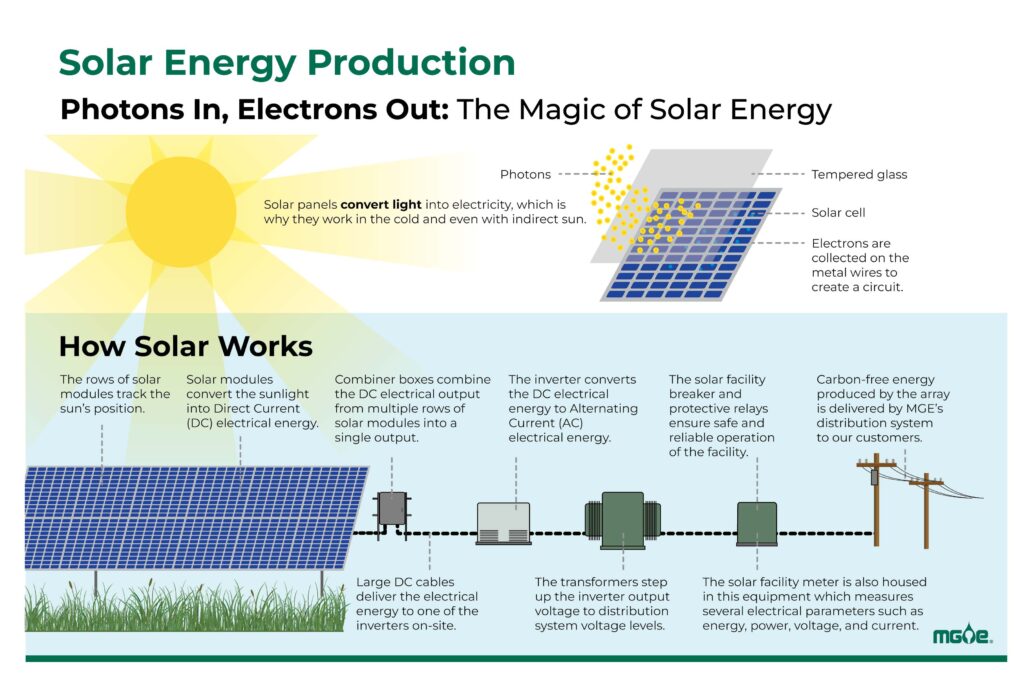
Solar panels capture sunlight and convert it into electricity through the photovoltaic effect. When sunlight strikes semiconductor materials in the panels, electrons are excited, producing direct current (DC) electricity. That DC power is then fed into a solar inverter, which converts it into alternating current (AC) for use on the grid or by electrical systems.
Additional information is available at www.mge.com.
The District is partnering with MGE because building, financing, and maintaining a utility-scale solar installation requires significant capital investment and specialized operational expertise. Under this partnership, MGE is better positioned to utilize its resources and expertise to handle all aspects of development, integration with the electrical grid, ownership, and ongoing maintenance.
While the solar energy generated will be delivered to the regional power grid rather than directly to the treatment plant, it contributes to the community’s overall supply of clean energy. This aligns with the District’s sustainability goals and reduces regional carbon emissions. The District continues to reduce its energy footprint through on-site initiatives such as biogas reuse, rooftop solar, and waste heat recovery.
The Nine Springs Solar array is expected to be 8 megawatts, providing enough energy to power about 1,750 households each year (based on typical MGE residential customer electric usage of 6,000 kilowatt-hours a year), which could power upward of 1,344 average U.S. homes per year. It is expected to offset approximately 9,450 tons of carbon dioxide (CO2) emissions annually.
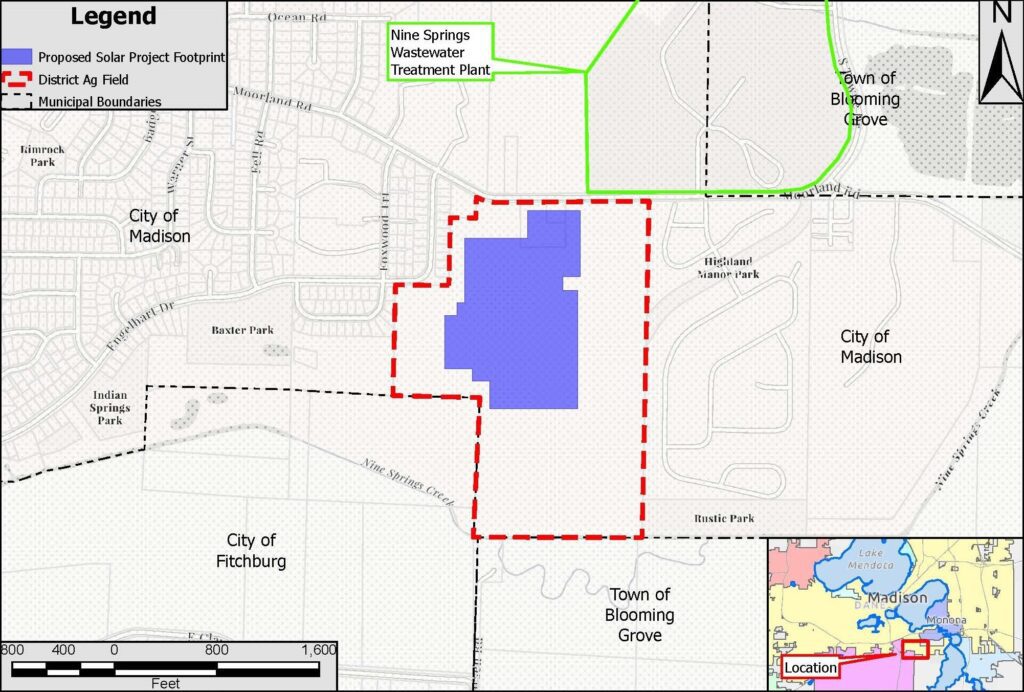
The entire tract of land is 94.5 acres. The solar project’s footprint is approximately 37.4 acres.
The District began working on this project in early 2025 and has completed the necessary City of Madison approvals.
The District has executed a lease agreement with MGE in mid-2026. Construction will begin in late September 2026, with substantial completion in June 2027.
The District handled land-use approvals and the lease agreement. MGE selected a developer to develop and construct the solar array, and once complete, it will own and maintain the solar installation.
The District worked with the City of Madison to ensure compliance with land use requirements. Given the size of the solar installation, it was not necessary to file an application for the project with the Public Service Commission.
Not at this time.
However, the District does have an existing 100-kilowatt solar installation on the roof of its Maintenance Facility. This installation generates approximately 75% of the power used by the Maintenance Facility and avoids about 98 tons of CO2 emissions annually. Additionally, it saves the District about $10,400 annually in electricity costs.
View our solar array monitoring tool to see part of our system performance and environmental savings. (Note that this monitoring tool only reflects the newer, 80kw portion of the District’s rooftop installation; 20kw was installed when the facility was built, and 80kw was installed in 2024.)
As it has previously, with numerous construction projects in the region, MGE will work with its selected contractor to ensure that the necessary safety measures are implemented during construction. A fence will surround the project once it is complete, and the site will be accessible only to personnel trained to enter solar farms safely.
This project will not increase District rates as the District is not paying for the construction, operation, or maintenance of the project. The District will receive a small amount of revenue for the land lease.
Energy use and solar generation
In a typical year, the District uses just over 33 million kilowatt-hours (kWh) across its 17 facilities in the MGE service territory. By comparison, the new solar array is expected to produce over 15 million kWh annually, thereby offsetting the District’s current electric load by 46%.
The Nine Springs Wastewater Treatment Plant recovers approximately 276 million cubic feet of biogas per year; in fact, the plant recovers enough biogas to supply more than 2,290 homes annually. This biogas is cleaned onsite and then used to power plant equipment, such as blowers, generators, and boilers.
The District also captures waste heat from large machinery, such as generators and boilers, to heat process water used at the plant.
As an organization, the District continually seeks ways to enhance its energy efficiency and increase its use of clean, renewable energy. We use multi-year plans to help guide the District as it considers upcoming aging infrastructure replacement projects.
The District owns a tract of land across Moorland Road from the Nine Springs Wastewater Treatment Plant that it has retained for future plant expansion. As that land will not be needed for a few decades, the District has decided to partner with MGE to lease a portion of the land to install a solar array for at least 20 years.
Residential and community impact
There are no anticipated long-term impacts to the neighboring residential neighborhoods. Solar panels produce no emissions while generating electricity, and solar arrays require minimal maintenance.
A general map showing the proposed location of the solar project is available here.
A common misconception about solar PV modules is that they inherently cause a lot of glare, posing a nuisance to neighbors and a safety risk to pilots. While in certain situations the glass surfaces of solar PV systems can produce glint (a momentary flash of bright light) and glare (a reflection of bright light for a longer duration), light absorption, rather than reflection, is central to the function of a solar PV panel. PV modules absorb solar radiation, which is converted into electricity. Solar PV modules are constructed from high transmission, low-iron glass and are covered with anti-reflective (AR) coatings. Modern PV modules reflect as little as two percent of incoming sunlight, about the same as water and less than soil or even wood shingles.
Glint and glare have not been an issue on past solar projects built by MGE; for example, Dane County Solar was installed next to Dane County Airport, along Highway 51. That project has not received any complaints about glare.
There have been no comprehensive studies on the impact of solar projects on local property values in Wisconsin.
Research by the Solar Energy Industries Association (SEIA) found that “large-scale solar arrays often have no measurable impact on the value of adjacent properties, and in some cases may even have positive effects.” At a maximum of 8 megawatts, this solar installation is relatively small in scale. The Association also notes that proximity to a solar installation does not deter the sales of agricultural or residential land.
Construction is expected to begin the week of September 28, 2026. Work is expected to take place during daylight hours.
Activity will be heaviest early on as equipment arrives on site, and traffic impacts will remain limited to a narrow portion of Moorland Road.
During construction, additional noise typical of construction projects may occur. Traffic impacts are anticipated to be limited to a narrow portion of Moorland Road as District property north of Moorland will be used as a storage and staging site during construction.
Once the project is completed, this site will be managed remotely, with around one or two operations and maintenance staff arriving when maintenance is required. This means that traffic to the site during operation will be minimal. The inverters, which are cooled by internal fans (which, on some projects, can contribute to increased noise levels at the property line), are located within the center of the site. Given the distance from the property line to the inverters, the neighbors should not be able to hear them running. The solar panels will follow the sun throughout the day on single-axis trackers. It is not expected that these trackers will contribute to noise at the property line.
No.
In its preliminary design, the project is expected to have a setback of around 90 feet from the western property boundary to the site fence and over 400 feet from the eastern property boundary to the site fence.
Community involvement
The District provided initial notification to the area alder, business association and adjacent neighborhood associations in late June 2025. The District sent a construction update to neighbors in the near vicinity of the project via USPS in September 2026.
Additionally, the District, along with MGE, hosted an open house on Tuesday, August 12, 2025. This was a drop-in event where interested individuals learned more about the project and the District. Postcards with meeting information were sent to residents near the planned project area.
Updates and information are also available on this webpage.
Please direct your questions to District staff through our contact form. We can help route your questions or feedback to the appropriate individual or organization.
