


Many salt applicators in the Madison area have adopted brining to use less salt and get better results when clearing pavement. For brining to be effective, you need the right equipment and the right conditions. Here’s what winter maintenance professionals should know about using brine.
More uniform application
Brine is simpler to apply than spreading dry rock salt. Instead of trying to control how granules scatter across pavement, brining allows for a uniform, precise application. This consistency helps crews avoid over-application and ensures treated surfaces perform as expected.
It should be applied in lines, not a full sheet, to leave some bare pavement exposed.
Timing is everything: Brine and weather conditions
Brine is most effective when applied under the right conditions. It can be used for anti-icing up to three days before a forecasted snow or frost event, as long as weather conditions cooperate.
- Pavement should be free of snow and ice at the time of application, and rain should not be predicted before snowfall.
- Winds should be below 15 miles per hour if loose snow is present.
- Pavement temperatures should be above 15°F, and dew points should be at least 3°F below air temperature. Relative humidity should be 70% or less. When air temperatures are below 20°F, ice may still form.
When these conditions are met, brine creates an invisible barrier that makes snow and ice much easier to remove later.
View an Anti-icing Decision Chart for salt brining from the Professional Snowfighters Association. Or, view the Anti-Icing Application Decision Flowchart from Wisconsin Salt Wise.
Tips for effective spread
For communities, contractors or facilities looking to adopt brining, a few best practices can make a big difference:
- Clear snow first. For best results, broom or plow surfaces before applying.
- Apply before precipitation. This technique works best as a preventative measure, not after ice has already formed.
- Invest in the right equipment. A quality tank (around 125 gallons) mounted on an application vehicle is a good starting point. Many operations retrofit existing equipment, like a Bobcat with a boom containing 8–10 spray holes for even coverage.
A presentation titled “Bitter Brine Reclaim for Winter Maintenance” offers helpful tips on brine capture from water softeners and how to fit a Bobcat with a brine tank for spreading, similar to what the District uses. You can also see Anti-icing Application Rate Guidelines from Wisconsin Salt Wise.

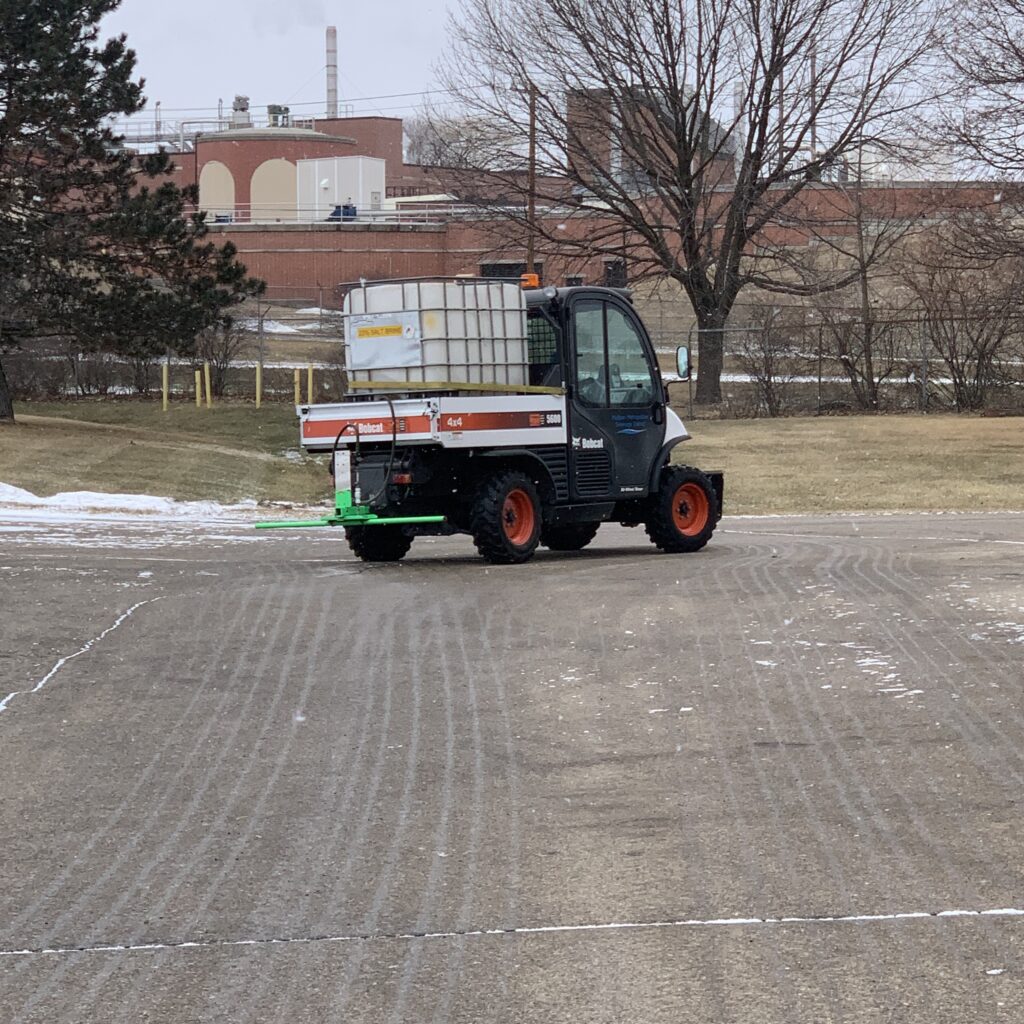

A small change with big impact
Brining may look subtle (just a few wet lines on the pavement), but its impact is significant. By preventing ice formation, improving plowing efficiency and drastically reducing salt use, brining helps keep roads and sidewalks safer while protecting our environment. As winter weather becomes more unpredictable, smarter strategies like brining allow communities to balance safety, sustainability and cost, without sacrificing performance.
Read why brine is better than rock salt for roads and sidewalks in our article titled “Brining for clear winter roads with less salt.” Visit the Brine (Salt + Water) page at Wisconsin Salt Wise for more information on brining, winter snow removal techniques and using less salt in winter. Or for general salt reduction tips, visit our chloride reduction pages.
